
Meet the CLiPers: The Garage School of Prepping Otherwise
Following the launch of CLiP #7: The Garage School of Prepping Otherwise, we’re excited to introduce the participants shaping this year’s edition: our CLiPers.
Selected through an open call earlier this year, this group of Rotterdam-based young people (ages 17–24) is spending six months exploring what it means to survive together in times of global crisis, social inequity, and ecological uncertainty. Through creative and practical methods, from LARPing and movement to foraging and mutual aid, they’re reimagining “prepping” as a collective, imaginative, and hopeful practice.
To begin our introduction series, we asked each CLiPer two questions:
If you could add one tool to a survival kit for your community, what would it be?
What does “surviving together” mean to you?
Meet the CLiPers
This year’s CLiP #7: The Garage School of Prepping Otherwise brings together an inspiring group of young thinkers and makers: Hooi-Ying, August, Aden, Leo, Nik, Camilla, Janey, Sophie, Urvee, Pavlos, Sol, and Anarcha.
Selected through an open call, each CLiPer offers a unique perspective on what it means to prepare, care, and imagine survival collectively. Through their words, we glimpse a shared practice of listening, making, and dreaming otherwise together.
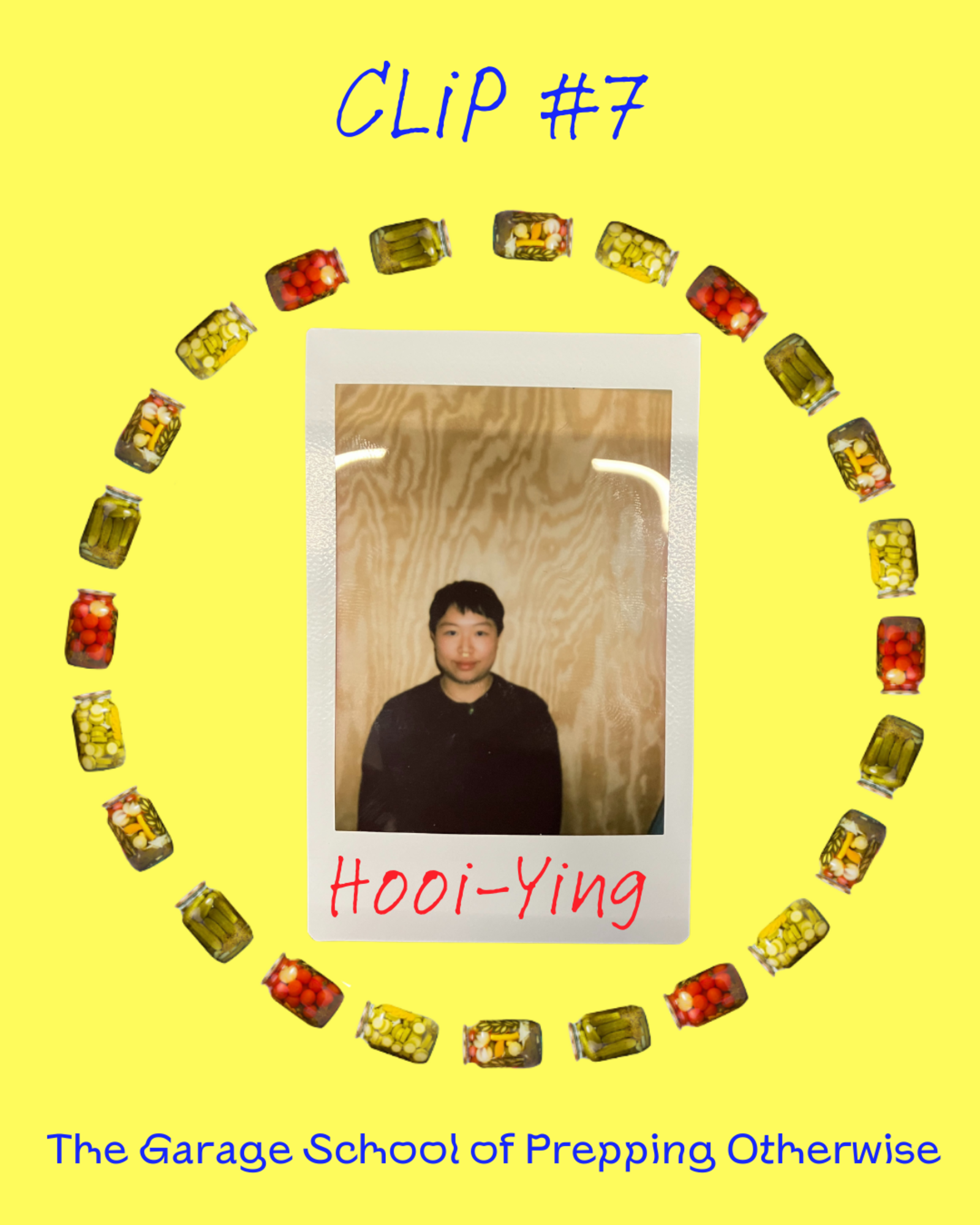
Hooi-Ying
What is the future?
When we address it outside of time.
Outside of linear time,
Time not dedicated to production.
What are we looking for?
When we don’t consider an end to move towards.
But the movement itself.
‘The dwelling’1
Can “the future” already be amongst us?
What if future can imply visions outside Western paradigms?
Or does future imply longevity?
‘The revolution is housework - you have to do it everyday’2
The future will not appear,
It will be revealed in the crevices of our footprints on wet soil.
It will be revealed in the rain,
And how we decide to define the storm.

Auguste
For the community survival kit, something I would add is: a table. I see it not just as a piece of furniture. I think it can be a place where people gather, share food, stories, knowledge, support, and more. Back home, the dinner table is probably the one and only place where my whole family consistently comes together. And I think any community needs a place like that where they can come together in such a way.
Surviving together, to me, means creating the conditions and space for mutual support, shared meaning, and responsibility, all through connecting with others.

Aden
I would add kinesiology tape to the survival kit for my community. Like I also mentioned in the interview, it is a very important item for me as a trans person and as a person who needs support from medical/physio items from time to time for my leg. I also think it is an item that can serve a community in these aspects, and many more, like sticking things together and even self-expression.
Surviving together means that nobody gets left behind based on their gender, race, age, ethnicity, sexuality, gender identity, or ability. The community supports each other in many ways without hierarchy, and people help each other to support whatever someone else might be “lacking,” or, to put it in a better way, make our differences come together to form a healthy and sustainable support system without the influence of power systems.

Leo
My addition to the survival kit would be a common archive. I believe it’s important for everyone to take part in archiving everyday life, preserving culture, development, and memories, allowing for reflection, whether in crisis situations or day-to-day survival.
Surviving together feels more hopeful than surviving alone. It pays attention to the general wellbeing of people as a social group and focuses not only on individual needs, which may become isolated and territorial. Surviving together allows us to exist with less fear and more support which is vital for truly surviving.

Nik
If I could add one thing to the survival kit, it would be Hormone Replacement Therapy :)
Surviving together means listening and looking out for each other, helping your neighbour carry their groceries, walking their dog when they’re ill, making sure you stand up for needs other than your own. Together is the only way it’s worth surviving.

Camilla
My contribution to the survival kit would be a solar battery, though it’s hard to answer without knowing what everyone else is bringing!
To me, surviving together means having a collective of people who pool their strengths and needs to maximise our ability to provide a sustainable and satisfying life for ourselves. It’s about each individual contributing every physical, mental, and emotional resource they can, knowing the group will reciprocate. Surviving together means relying on yourself and your peers, acting with devotion to a shared vision of the future you’ve conceived together.
Janey
If I could add one tool to the community survival kit, it would be ginger, because it has many health benefits: reducing inflammation, easing nausea and indigestion, and strengthening the immune system.
Surviving together, for me, means finding a way of living that is comfortable and durable. It’s about creating an environment that feels safe and trusted.

Sophie
My addition to the survival kit would be a needle and thread, for patching up our clothes, or for making new ones, and using time spent for another as a medium of care. Folded and warped enough times, it becomes string, woven through a hole enough times, it becomes fabric, stronger and more cared for than before.
Trees in forests can send resources and information to each other through a network of mycelium connected to their root systems underground, and larger, older trees send sugars and nutrients to younger or more vulnerable ones in need. They also share chemical distress signals when one encounters a threat so the others can prepare and, if possible, provide help, often between different species. Connected to one another, they are stronger. I think that surviving together means creating and using our own “fungal” network of interconnectedness and care, reaching out and finding the grip of another outstretched hand, and learning to trust its roots.

Urvee
Something I consider an essential non-essential is my pack of playing cards. It has two decks, so it can also be used with a bigger group. Playing together is a great way for people to get to know each other better, and it is important to have some kind of "luxury" in a survival situation; some way to keep in touch with the lighter side of things, of humanity. Sure, playing or having fun might not be everyone's priority, but it's nice to have some form of an escapist outlet, and with cards, you get to do that with other people. Playing cards can also be used as a way to settle arguments in a non-violent way. However, if things do get violent (say, you're getting attacked), they are handy weapons of self-defense if you know card throwing (Now You See Me, anyone?)
'Surviving together' to me is seeing things through with people. It is trying to get through the trials and tribulations of life, capitalism and the climate crisis together, while working on making things better for our future generations, our future communities. 'Surviving together' is complementing each other, sharing your skills, helping your people, even if it might be a bit inconvenient at times. It is showing up, taking responsibility, taking care of yourself and others, it is asking for and receiving help when you need it. It is reliance and resilience in the face of dark times.
Pavlos
If I could add one tool to a survival kit for my community, it would be The Shared Pot: a symbolic tool representing collective care and shared knowledge. This object relates to the practical aspects of life, while also recognising the importance of sharing this knowledge with others. In emergencies, we often face situations we have never encountered before and are forced to come up with tools or solutions to get through them. This kind of knowledge should not remain individual, but be shared in a common repository of tools and experiences from which everyone can draw and contribute.
For me, surviving together means creating a network of care and mutual support rooted in shared experience. Most of the people in my community are friends who, like me, moved from Greece to the Netherlands to study and work in art-related fields. Coming from a country shaped by a long financial and social crisis, we learned early on that survival often depends on collective effort. Here, away from home, we continue that practice: sharing resources, knowledge, and emotional support to navigate everyday challenges.
Art plays a central role in this process. It’s not a detached or purely intellectual activity, but a tool shaped by urgency: a way to connect, to understand one another, and to imagine alternative ways of coexisting. Surviving together is therefore both practical and imaginative: caring for each other while building the means, through art and solidarity, to endure and to dream collectively.

Sol
The tool/object/thing I would add to the community survival kit would be a big big surdo drum. The one that when played you feel resonate/rumble/echo throughout your entire body. With joy, confidence and a sense of anchoring, it gives me (and I hope the people around me) the confidence needed to move forward towards collective action, in unison (rhizomatic). I really emphasize on the feeling of the bass on your insides, frees my mind of fear.
Surviving together comes up in my mind as a spiral, a puzzle, a net and/or a circle.
Surviving together is mutual support, accountability and responsibility. Is recognizing your needs and desires as well as your limits and hardships. It's a continuous check-in with yourself and those around you (human & non-human). It is distribution, strategy, companionship, cunning, conversation, a search for joy and pleasure in situations where there seems to be none. It's a transversal complicity.
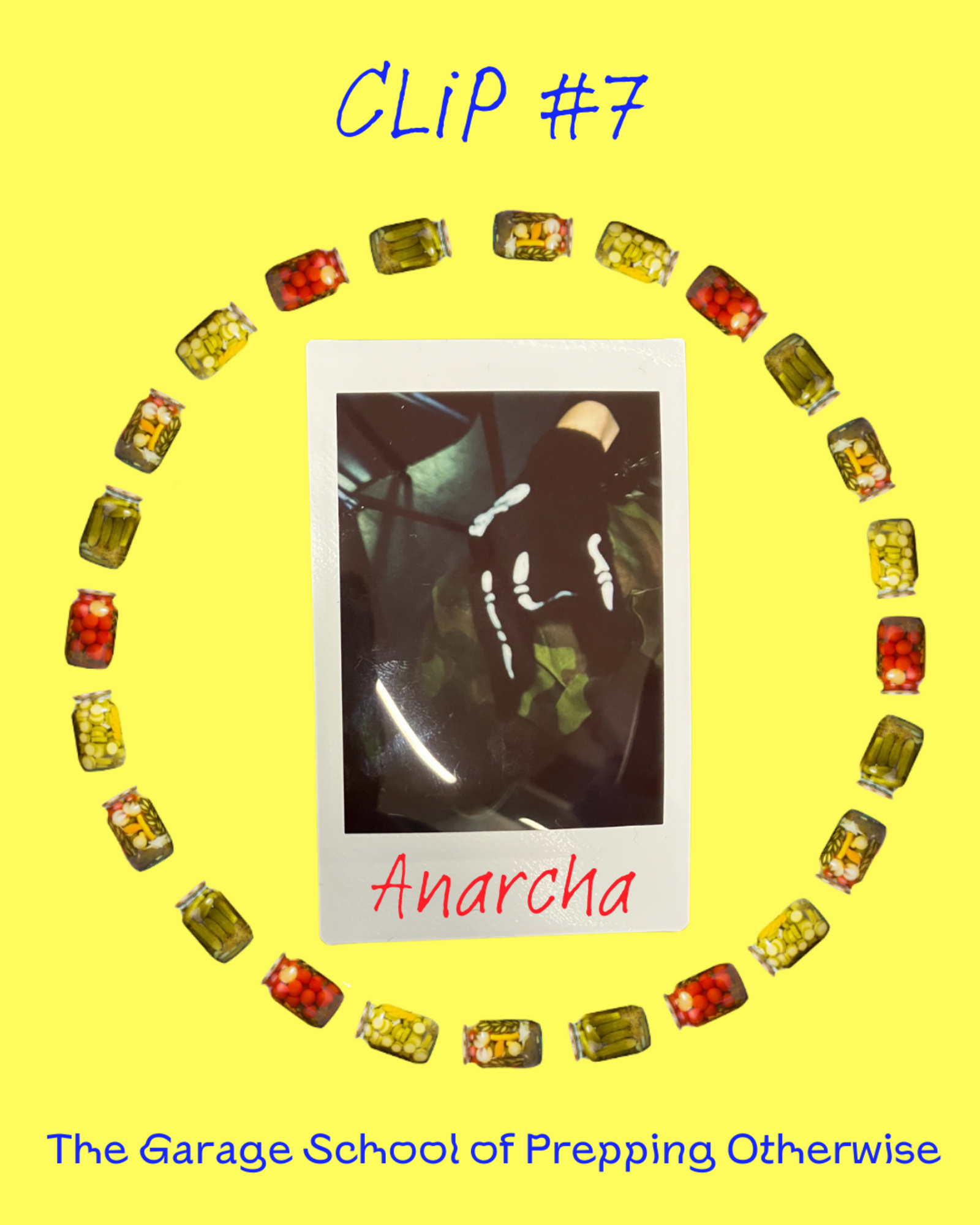
Anarcha
CLiP #7 is made possible with the generous support of Stichting Mostert-Van der Meijden, Fonds 21, and the Fonds voor Cultuurparticipatie.