

Monthly Suitcase Economy Brunch is a testing ground for experimenting with relationships, translation, economic models, transformation and time through the preparation and serving of food. In this series, artist Riet Wijnen is developing a method to build connections among different local daily contexts, past and present, by researching local histories of preservation and fermentation.
These centuries-old methods for extending the lifespan of agricultural products through transformation are evident in the practices of various cultures. As people moved around, these preservation and fermentation methods spread and evolved. For example, sauerkraut is based on the Chinese tradition of preserving cabbage in rice wine. These methods were developed when people were largely self-sufficient, relying on informal barter economies to provide themselves with food year-round.
Each brunch involves a process of fermentation or preservation and an ingredient transported from one place to another via suitcase.* The menu predominantly features food from Limburg, a province in the south of the Netherlands where the artist was raised, South Korea, and South Africa. The specific regions in these two countries will be determined by collaborators of the Monthly Suitcase Economy Brunch series.
For Monthly Suitcase Economy Brunch #9, Donghwan Kam proposed a meal, which he will prepare with Riet. Yeolmu Guksu (열무국수), a refreshing Korean cold noodle dish made with somyeon (소면), thin wheat noodles, served in an icy, tangy broth made from the brine of yeolmu kimchi (열무김치), young summer radish kimchi. On the side, dubu (두부), homemade tofu, is served with cheongjang (청장), which literally means clear soy sauce, as it is the lightest and youngest variety of traditional Korean soy sauce. For dessert, gotgam Mari (곶감말이), dried persimmons with walnuts and cream cheese, is served.
The main ingredient, yeolmu kimchi (열무김치), is a summer kimchi made with young leafy white radish. Once prepared, the kimchi is left at room temperature for about one day, then transferred to the refrigerator. After four or five days, this lacto-ferment reaches its best flavour.
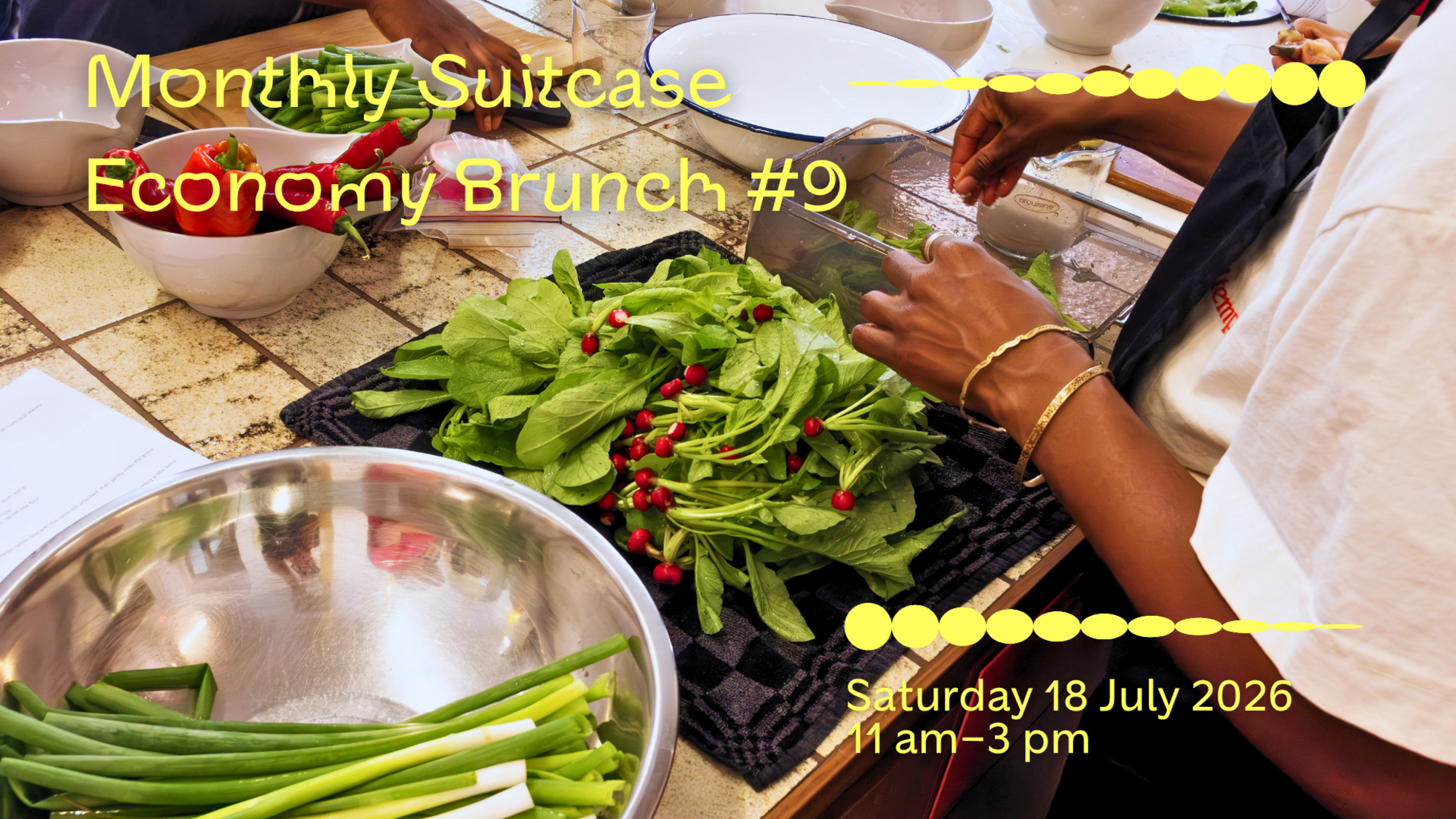
Last week, Suitcase Economy Workshop #1: Yeolmu kimchi, led by Donghwan and Riet, took place at Kunstinstituut Melly. Together with twelve participants, Donghwan and Riet experimented with translation in the workshop by replacing some of the ingredients in the original Korean recipe with ingredients commonly available in Dutch supermarkets. Six different versions were made: one with yeolmu, one with more leafy mini pink radish, and one with normal pink radish, all also translated into a vegan variation.
Cheongjang (청장), like yeolmu, is also considered a young ingredient. Although the word cheong originally refers to the colour blue or green, it can also mean ‘young’ or ‘not yet mature.’ Cheongjang, literally meaning ‘young soy sauce,’ is soy sauce that has only recently begun its second fermentation. Soy sauce is made through a two-step fermentation process. The first step is solid-state fermentation, in which cooked soybeans are formed into soybean blocks and fermented. The second step is brine fermentation, in which the fermented soybean blocks are immersed in saltwater and fermented further.
When Donghwan and Riet met in Venice earlier in May, Donghwan gave Riet a palm-sized meju (메주), a fermented soybean block that he had made himself while attending a fermentation school in Jangheung. He had soaked the soybeans, cooked them, and kneaded them by hand before shaping them into a block; then he let it rest to start a wild fermentation. In Amsterdam, Riet submerged the meju in a brine that she prepared and began fermenting it into jang, which means fermented sauce. Once the meju had sufficiently broken down in the brine, Donghwan and Riet separated liquid and solid. The liquid became soy sauce, while the solids became doenjang (된장), fermented soybean paste. Although soy sauce usually takes about two years to mature before being consumed, the very young soy sauce is sometimes used in cooking. It is this young soy sauce, cheongjang, that we serve alongside the tofu.
We will serve iced tea with lemon, verbena and elderflower or rooibos and rhubarb, made with the staple syrups of Suitcase Economy.
10 euros, or 5 euros (drinks not included) if you bring either a homemade fermented or preserved product, the recipe for it, harvested produce from your own garden, or a specific ingredient for cultural dishes.
11:00-15:00, or until we run out
Suitcase Economy / Ground Floor, Kunstinstituut Melly, Witte de Withstraat 50, Rotterdam
* Monthly Suitcase Economy Brunch #9 is made with yeolmu (열무), young summer radish, hong-gochu (홍고추), fresh pepper, maesil-cheong (매실청), Korean plum syrup myeolchi aekjeot (멸치액젓), anchovy sauce, liquid of saeujeot (새우젓), salted shrimp, mejukong (메주콩), dried soybean, meju (메주), a dense block of boiled, mashed and soybeans that are naturally fermented and gotgam (곶감), dried persimmon, all brought from Seoul by Donghwan. He also brought dried sea salt from Shinan, which Black Rose gifted him, and which she had left on her rooftop for three years to allow the bittern to drain away naturally.
Kunstinstituut Melly will be closed to visitors from 5 to 23 October as we prepare the building for the opening of You will find us in the best places on 24 October.